


PC, ABS or PC/ABS: which material fits which application?: a technical view for product development, tooling, process engineering and sourcing, focused on rob
Key takeaways
- Process, material and tooling must be evaluated together.
- Single data-sheet values do not replace a process window.
- Good data reduces trial and error, but not engineering responsibility.
- Supplier information is useful, but must be checked against the application.
Why the topic matters
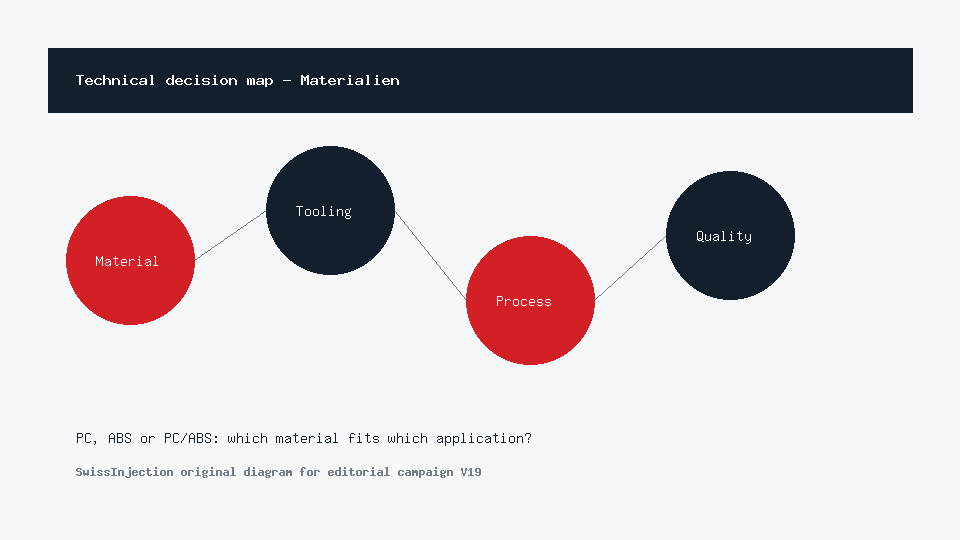
In technical injection molding, quality rarely comes from one perfect setting. What matters is whether part design, material behavior, tooling concept, machine capability and inspection strategy form a stable window together. PC, ABS or PC/ABS: which material fits which application? therefore belongs in early project clarification, not only in troubleshooting after first trials.
Technical levers
The relevant levers interact: flow behavior, thermal control, pressure build-up, cooling, demolding, dimensional references and documentation. Optimizing them separately often moves the problem rather than solving it. Robust industrialization means making the limits visible and producing deliberately inside them.
Engineering perspective
For product development and sourcing teams, this is important because early choices later determine tooling cost, scrap, sampling effort and production risk. A small design or material decision can change the whole processing strategy. Every specification should therefore name the assumptions that must be verified.
Limits and common mistakes
Common mistakes include tight tolerances without process evidence, unverified material substitutions, missing measurement strategy, unclear release limits and late involvement of toolmaking. Digital data and assistance systems help, but they do not replace DFM or disciplined mold trials.
A useful next step
SwissInjection connects DFM, process thinking, supplier communication and production data. A compact review shows which risks are truly critical and which checks are useful before production release.
Sources
- BASF — Engineering plastics portfolio (Manufacturer, accessed 2026-09-01): https://plastics-rubber.basf.com/global/en/performance_polymers/products
- Polyplastics / Daicel — DURACON POM product information (Manufacturer, accessed 2026-09-01): https://hpps.daicel.com/global/s/ProductInfo/duraconpom?language=en_US
- EMS-GRIVORY — High-performance polyamides (Manufacturer, accessed 2026-09-01): https://www.emsgrivory.com/en/products-markets/products/